
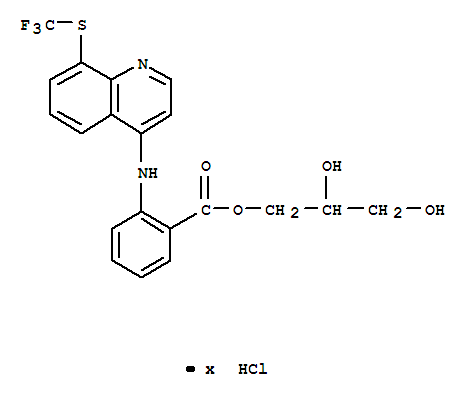
2,3-dihydroxypropyl 2-[[8-[(trifluoromethyl)thio]-4-quinolyl]amino]benzoate hydrochloride
- Name: 2,3-dihydroxypropyl 2-[[8-[(trifluoromethyl)thio]-4-quinolyl]amino]benzoate hydrochloride
- CAS: 54494-56-3
- Purity: 99%
Details
Chinese factory supply 2,3-dihydroxypropyl 2-[[8-[(trifluoromethyl)thio]-4-quinolyl]amino]benzoate hydrochloride 54494-56-3 in stock with high standard
- Molecular Formula: C20H17 F3 N2 O4 S . x Cl H
- Molecular Weight: 474.8811296
- Vapor Pressure: 4.85E-14mmHg at 25°C
- Boiling Point: 574.5°C at 760 mmHg
- Flash Point: 301.3°C
- PSA: 116.98000
- LogP: 4.97530
2,3-dihydroxypropyl 2-[[8-[(trifluoromethyl)thio]-4-quinolyl]amino]benzoate hydrochloride(Cas 54494-56-3) Usage
|
Molecular weight |
459.9 |
|
Structure |
A quinoline ring with a trifluoromethylthio group, an amino group attached to a benzoate molecule, and a 2,3-dihydroxypropyl group. |
|
Stability |
The hydrochloride salt form makes the compound more stable and suitable for pharmaceutical applications. |
|
Potential uses |
The compound may have potential uses in drug development for therapeutic purposes such as antibacterial or anti-inflammatory treatments. |
|
Research status |
Further research and investigation are necessary to fully understand the potential applications of 2,3-dihydroxypropyl 2-[[8-[(trifluoromethyl)thio]-4-quinolyl]amino]benzoate hydrochloride. |
|
General Description |
2,3-dihydroxypropyl 2-[[8-[(trifluoromethyl)thio]-4-quinolyl]amino]benzoate hydrochloride is a chemical compound that is a derivative of quinoline. It consists of a 2,3-dihydroxypropyl group attached to a benzoate molecule, connected to a quinoline ring that contains a trifluoromethylthio group. The hydrochloride salt form of this compound makes it more stable and suitable for pharmaceutical applications. This chemical may have potential uses in drug development, as it exhibits unique properties and structure that can be utilized for various therapeutic purposes, such as anti-bacterial or anti-inflammatory treatments. Further research and investigation are necessary to fully understand the potential applications of this compound. |
InChI:InChI=1/C20H17F3N2O4S.ClH/c21-20(22,23)30-17-7-3-5-13-16(8-9-24-18(13)17)25-15-6-2-1-4-14(15)19(28)29-11-12(27)10-26;/h1-9,12,26-27H,10-11H2,(H,24,25);1H
Related Products
-
-
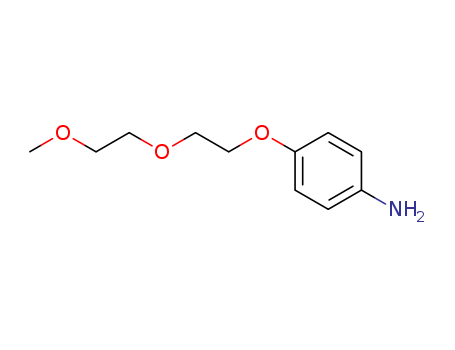 4-[2-(2-methoxyethoxy)ethoxy]aniline
CAS:65673-48-5
-
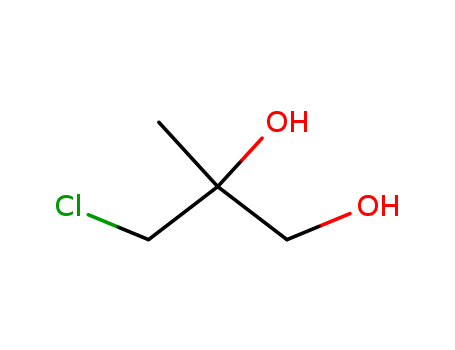 3-chloro-2-methylpropane-1,2-diol
CAS:597-33-1